Writing Territories

This week I have been leading the LMWP institute fellows into a writing life.  On day 1, I ask them to consider the fundamental question:  why do humans write?  What purposes motivate us to write?  What verbs do we use to describe what we hope to accomplish with the variety of types of texts?  On day 2, I lead a discussion of audience.  For whom do we write?  Does it help or hinder writers to hold their imagined audience in mind as they draft?  Should we, as Peter Elbow recommends, “close our eyes as we write” the first draft, and only revise with audience in mind.  We also discussed the difficulty of writing for audiences who we don’t know very well.  Kids who write for adult teachers.  College freshmen who write for faculty.  New faculty who write for scholarly journals.    I modeled making a list of audience that inspire me to write.  I realized that even the same people, like LMWP TCs, are two different audiences when I think of them as teachers and as researchers.  Similarly, I want to write advice about how to improve the teaching of writing for an audience of GVSU SWS instructors and for those GVSU instructors as potential research partners.  I also want to write to my children, but my purpose changes (and thereby my topics, tone, and diction) according to the age at which I want them to read the text.  Am I writing for Caroline to read now as a 6 year old?  Or am I writing to her as a 16 year old trying to figure out how to be a a healthy adult?  These same physical people can be different audiences.

I also have a couple of aspirational literary journals (Fourth Genre and Brevity) to which I would like to send essays.

With my writing group today, I realized that my most pressing purpose is to entertain this audience of 2015 LMWP fellows.  I want to write something to read aloud (tomorrow and on our final Thursday) that will delight in some way.  I asked my writing group to flood me with questions about living in Utrecht last year.  I want to know what is of interest to them.  Having an immediate and familiar exigence is helpful.

Another favorite thing about our year in the Netherlands: neighbors with kids

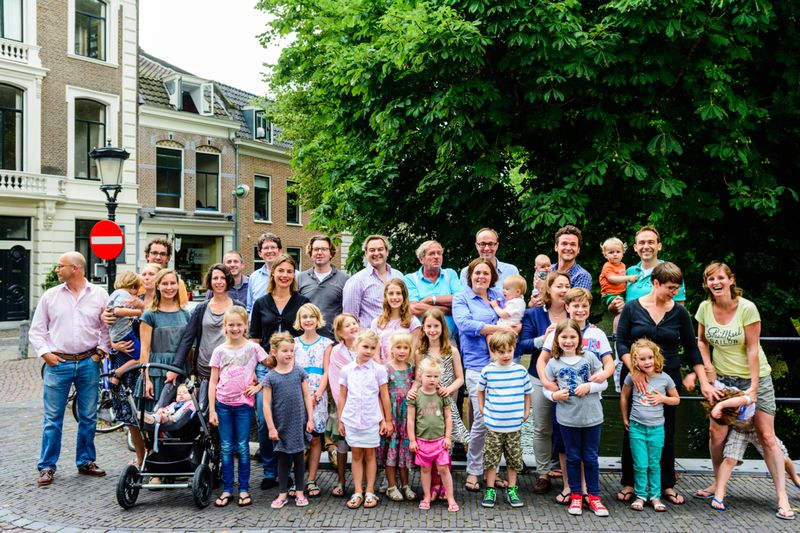
Another favorite thing about living in the Netherlands this year: next-door neighbors with children.  While Steve and I chose where we lived this year very carefully, we got even more than we were hoping for.  We hoped to live without a car in a historic city within easy commuting distance to Amsterdam where there was an international school for our kids.  It took us months of research and good luck to find this house in Utrecht.  Google Earth helped us to scout out the neighborhood before we signed on the dotted line.  But what we could not know, and could not even imagine, was the special enclave of young families into which we stumbled.  There isn’t space here to do justice to the appreciation we feel to our neighbors.  They have welcomed us, invited us to dinner and birthday parties, taken us for boat rides, signed our kids up for gymnastics, art, and horseback riding with their kids, and taught our kids more Dutch than they learned in school.  We have been so blessed.

buuv photoOur neighbors told us that they had an annual neighborhood photo tradition, see above. Tonight, they confessed that it was staged for our benefit, and gave us an album with shots from the year.  Thankful!

Architecture

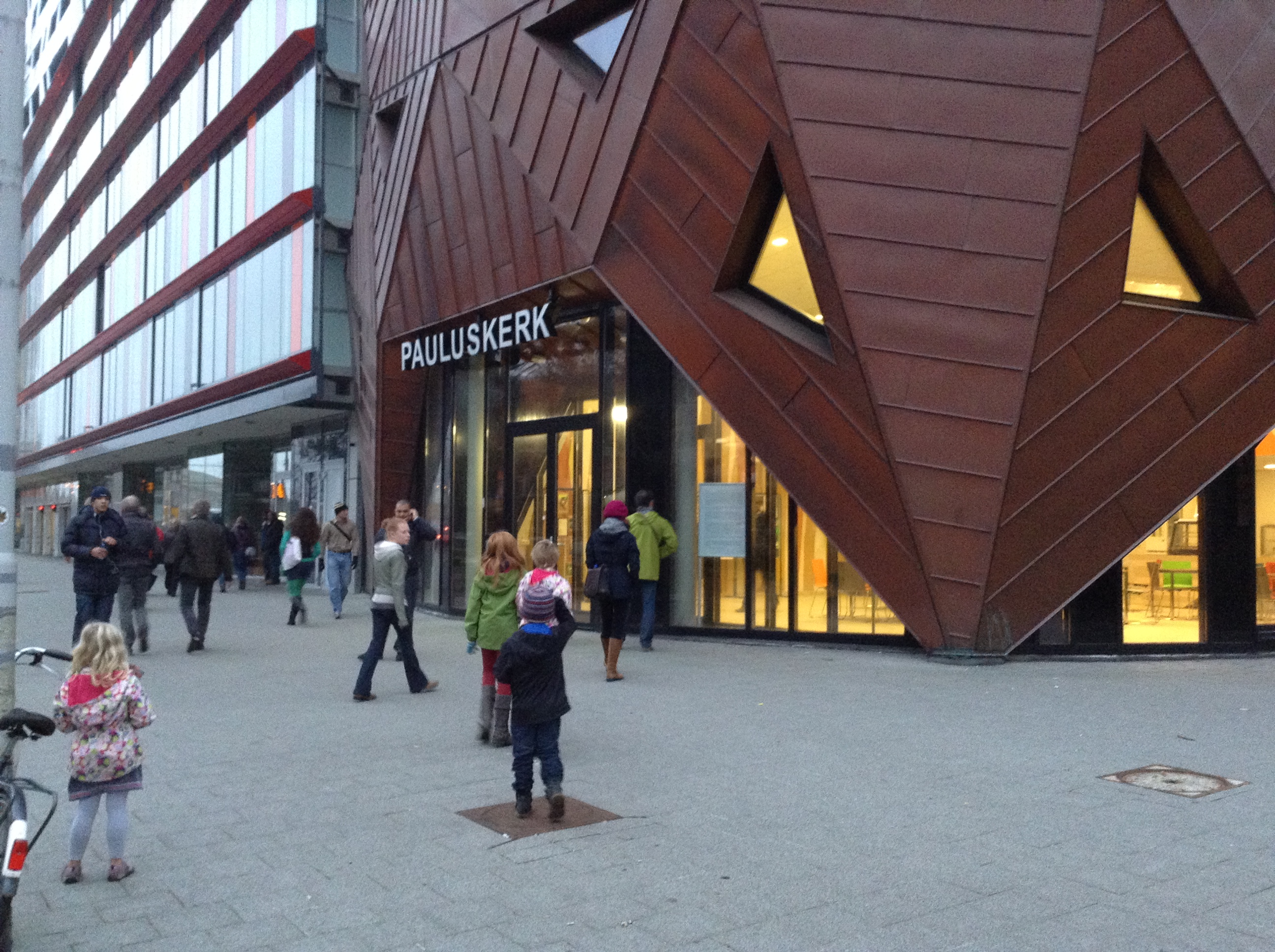
Nine days to go! This year I have relished architecture. Everywhere we go, we encounter something to see: charming 17th century row houses, soaring cathedrals, Amsterdam School brickwork, or innovative new design–sometimes in the same block. We are living our daily lives within a rich and varied built environment.

IMG_0569

IMG_0587

IMG_0676

IMG_0682

IMG_0683

IMG_0848

IMG_1090

IMG_1122

IMG_1123

IMG_1164

IMG_1275

IMG_1334

IMG_1364

Frame

I ran across this poem today while reading an article in English Journal about the Toulmin model of argumentation.  What a serendipity.

Frame

Even as we watched from my writing class

a man kick the trashcan in front of school,

yelling I will not eat your fucking garbage,

my students had the decency not to laugh,

but to settle into their desks to write.

One student, a Hindu girl, asked to be

excused, and we watched her at the curb

give the man her sack lunch.  I remember

thinking at the time, that we can begin

and end each day with even: even

as the sun crests the eastern edge of

the ridge, a peregrine swoops from

the gargoyle on the Commerce building

and takes a pigeon from the street; even

as the sun melts the horizon like an egg

yoke, the old woman pushes her rubble

from 8th Avenue into the alley full

of dumpsters, and one has to admire

how sweetly she cares for the faded baby-

doll in the child sear of her grocery cart.

–Bill Brown

English Journal July 2010

Sunrise

I’ve got a cold. The pesky virus came home with Caroline from kindergarten and infected both Margaret and me this week. I’m on the mend, but last night I went to bed early (again), missing the Dutch bluegrass band concert to which I’d purchased tickets. Steve said it was great. The audience seemed kind of bewildered by a musical style unfamiliar to them, though the band spoke Dutch to introduce their numbers.

Early to bed means early to rise, so although I didn’t set an alarm, I woke up when the bedroom grew a fraction lighter. I happily found that I had enough time to walk up the street to the sunrise service at the Domplein (cathedral square). The rest of the family was silent while I pulled on a sweater and jeans and crept out the front door.

The crowd was less than a hundred people singing along to music led by a trumpet. As you might imagine, some tunes were familiar, and I know enough Dutch phonics now to sing along with syllables whose meanings I don’t get.

In front of us as we sang stood the Dom cathedral (the choir and transept are all that are left after a hurricane blew down the neglected nave in 1674). Behind us stood the Domtoren (bell tower). RDMZ01_ST-1213_WI’ve climbed the Domtoren about four times now, all one hundred and ten meters of winding stairs. It is simply lovely–a beautiful stone lace north star to any lost tourist who needs to find the center of town. Over half way up, visitors get to walk among the massive historic bells, fourteen of which were forged in 1505. I’ve spent a cumulative hour reading their personified inscriptions, which sound like this: “I am John the Baptist. I will preach baptism and God’s power to all the people.” On our last tour, when asked when these historic bells were played, the guide replied that each bell requires several persons’ effort to pull, and they are only played a few times a year, like Christmas and New Year’s Eve at midnight.  One level higher in the tower are fifty much smaller bells whose melodies I often hear on Saturdays when the city carillon player gives her weekly concert.

During our last hymn, to the tune of “Thine is the Glory,” a lone bell began to sound in the tower above us. A second soon joined, then a third. Soon the bell tower was the center of attention. The crowd turned in unison and looked up.

I got to hear the bells. The really old ones.

They sounded like Pentecost–everyone talking in different languages. They were each ringing in their own rhythm and pitch, unrelated to the others–fourteen singers belting out different hymns of praise, shouting different tidings of good news. The noise was all encompassing. I contemplated hurrying home, because I thought for sure that they would wake and awe my family. (They didn’t.) But I stayed with the crowd and just marveled at the noise. Having climbed the tower and walked among those massive bells while the wind whistled through their silence several times, I felt affection for them. I’m so glad that I got to hear their voices once while we lived here.

Easter morning.  Sunrise.

http://www.domtoren.nl/en/page/historie-domtoren-en-domplein


Birthday

This year I had a birthday reminiscent of my childhood: surprising, magical, and warm. Growing up in Atlanta, the middle of March is usually host to a visual celebration of cherry and pear tree blooms. The daffodils might still be lingering. Decorative gardens have been planted with pansies, violas, and impatiens. Spring is springing.

In Michigan, as Steve recently texted me, March is the color of a dead deer on the side of the road.    March is the dirt left behind when the pile of snow begins to melt–or it is fresh snow. Or it is a cold, freezing rain–rain makes you realize that snow is nicer. The utter miracle of resurrection is still a month away.

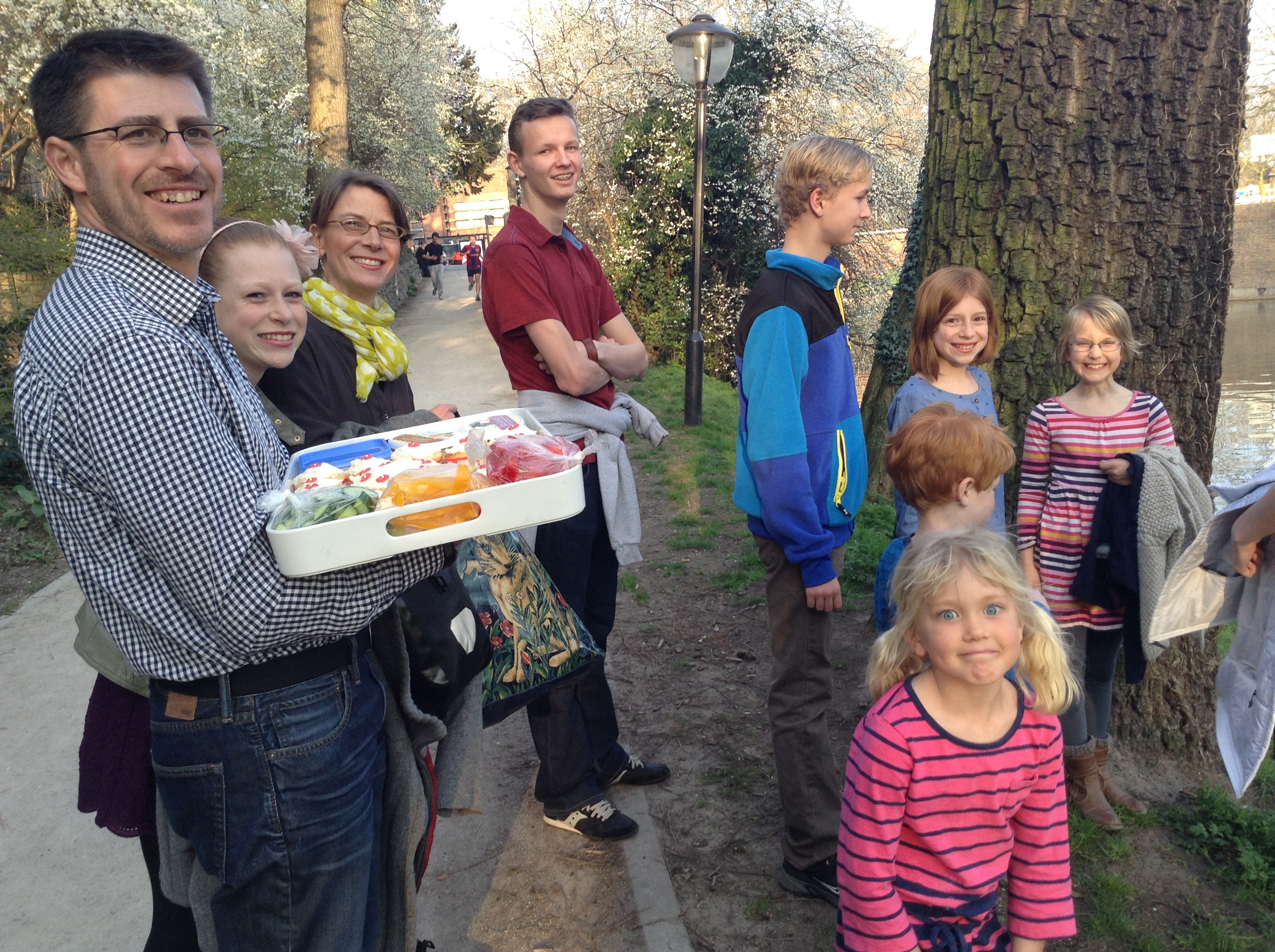
photo-25This year, my birthday lunch was a picnic in Wilhelmina park. It was warm.  Steve and Brian played ping pong on the permanent tables next to the play ground. The kids took turns on two sets of roller blades, holding hands for stability. The women lounged on blankets and watched the crowd of college students grill rookworst, drink beer, and kick soccer balls.  photo-24My sister and her family were visiting. For dinner, Steve surprised us with a boat hire to cruise our group of fourteen around Utrecht’s canals.  Along the banks, the crocuses were blankets of purple, and the daffodils were beginning to open up.  The Staggs baked me a cake.  Brian held it aloft as he biked from home.  On the top was a candelabra from Tiger Direct that reminded me of the playful crystal chandelier in our otherwise modernist row house.  On the canal boat, we drank prosecco and dipped fresh vegetables from the Turkish groceries on Kanaalstraat into homemade pesto.

photo-22 Against this scenery, we are the actors. I’m still me, with my fierce loves, my anxiety about living up to my own standards, my impatience, and my effort every day to just breathe and enjoy myself and others.  This year, our setting is just about perfect. I pedal my bicycle along the most lovely backdrops imaginable. Every day. And soon (it feels so soon) we will get back into our automobiles and zoom down highways. That near end point changes how we live in this space, trying to notice every little thing. Every inconvenient wrestling match with a bike chain lock is novel. Every blue sky is another gift. Every chill on my skin reminds me that I’m outside, using my legs to get around, rather than stuck in traffic.

Margaret, at age 8, is homesick. She wants to go home, and to her this year feels endless. She misses her teachers at Stepping Stones. She misses building forts in the basement.

For me, at age 41, a year has never felt more ephemeral.

Inner-argumentation

In my last post, I challenged myself to write my way through an actual decision I’m facing.    I want to better understand writing as a tool for decision making.  When is writing a useful strategy?  When is writing too cumbersome a tool for the task?  In what ways is my intrapersonal argumentation like and unlike interpersonal argumentation?

Hair

It seems like a simple question, whether to get one’s hair cut, but as with most decisions in our interdependent society, my choice influences others and thereby has political implications.  Most decisions are small, but their force is big when multiplied by thousands of people, even millions (I could say billions, but there are not too many decisions that are the same facing all individuals across the world).  The choice to buy a car that gets 25 miles to the gallon rather than 20, for example, has a significant impact on oil trade and air pollution when multiplied by hundreds of thousands of American consumers.  The choice to buy a bottle of water and throw the bottle away…well, most of us have realized that these small choices make a landfill.  When my first cousin had her first child, her husband, an ecology professor, calculated the environmental impact of plastic versus cloth diapers, factoring in the water and detergent usage of washing the latter and the trash of the former.  They went plastic in the end.

But a haircut?  How does this have environmental or political consequences?

Well, to me it’s all about time and mental focus.  How do I spend my time and my productive thinking?  Do I spend it on myself, or do it spend it working to make the world a little bit better for others?

My friend Christina recently wrote a Foucauldian analysis of the preoccupation on bodily transformation of the citizens of the Capitol in the Hunger Games.  These folks were distracted away from political engagement by their concern for their bodies.  Their minds (as mine is in this essay) were focused on questions like: should I get my hair cut?  What color should it be?  What new style of clothes and make up should I don?

And that’s just the mental preoccupation.  Every day, many women across the country spend an extra 30 to 60 minutes that men don’t spend on their appearance.  We shave legs; we brush, dry and curl long hair; we put on makeup; and we assemble complicated outfits through trial and error in front of a mirror.  Every minute that we are thinking about these things, we are not thinking about how to phrase strongly worded emails to our Senators or even how to phrase notes of encouragement to our children.

I gave up shaving my legs a couple of decades ago, not on any aesthetic principle, but on a use-of-time principle.  I would rather spend the ten minutes a few times a week working: writing, reading, or talking to someone about how they are doing.  A few times a year, I pull out the clippers and shear off the season’s growth, like the shepherd of a malnourished sheep.  Yes, generally speaking, my choice is a feminist one, in that I don’t think women should have to spend more time on their appearances than men do.  If we as a sex are consistently spending more time on our bodies, then we as a sex are collectively spending less time having an impact beyond our selves.

But what if we enjoy it?  I admit that I spend twenty minutes a week–the time I would spend shaving my legs if I did so–making coffee.  Drinking it not included.  I also love warm showers, and I don’t take them to maximum efficiency in order to get to work quicker.  Instead I savor the heat on my skin, and say words of gratitude for the pleasure.

I like getting my hair cut, too, but it takes a whole hour, or more, if I book an appointment at a salon.  I think I’ve done it five times in the last fourteen years. Steve usually cuts my hair–with the skilled precision of a knife-wielding doctor, which is what he is.  For years, I’ve just asked him to cut it in an even line all around the bottom.  And he does.  I used to ask him to cut it at a nice, face-framing, chin length bob.  It looked cute just peaking out below the rims of ubiquitous hats I wear in the winter.  For the last five years, I’ve kept it long, asking for only the occasional clean-up trim. This has allowed me to wear it up in a twist, or in two low pig tails if I’m feeling sporty.

You see, I have “fine” hair, if we are being polite, and super thin hair, if we are being honest.  There’s not much of it.  There is even less of it since having two kids.   Lately it seems that the hair in front is always breaking, giving me bangs where I did not intend them.  If I want to wash and go, be showered and out the door in half an hour on a daily basis, then is it time to go short again?

Ten years ago I had it cut pixie short–in a salon.  I liked it, a lot, but before I knew it, it had grown out again.  The thing about short hair is that you have to keep making appointments to see a professional.  Appointments cost time–and money.  How much cash have I saved by having Steve cut my hair these last fourteen years?  At least a thousand dollars, I think, if I multiply it out.  How much time have I saved?  Time spent at the salon is time not spent enjoying my family, preparing for class, or grading papers.

Or could it be?  I’ve brought a book to the salon before, and I feel a bit rude reading while the hair artist works.  I haven’t let that stop me other places, though.  I more often read than talk to the stranger next to me on an airplane, and sometimes even read rather than talk to other parents at the park or indoor kids’ gym.  Maybe I could get my hair cut and read for work too–saying grateful words while having my hair washed and scalp massaged at the beginning.

Reading is working, so maybe the only time wasted is the meeting and the transit time.  Since time spent getting around here in Utrecht  equals a bike ride across a city that never ceases to delight me–that isn’t wasted time either.  I’m both exercising and visiting Europe–two things that make my list of priorities.

Getting my hair cut, too, would save me time with a hair dryer on a daily basis.  Hmmm, this is looking like the more powerful option by the minute.

What if I get it cut and don’t like it, thereby distracting my mind back onto myself and off of the other people and tasks at hand?  That’s within my control, and I really do like hats if all else fails.

Maybe I will get my hair cut.

Unplugged

Tonight we are packing up. Tomorrow our taxi picks us up at 5:00 am for a flight to Zurich. That kids are homesick for snow. I am trying to decide whether or not to leave my laptop behind. If I do, that would be a clear sign that I am not working this week. Maybe that’s a good thing, to signal that my focus is on the kids. Time to unplug.

Far

“Mom! Sometimes I wish we had a car. Do you?”

I couldn’t blame her, shouting at my back as we pedaled the way we had just come, into the wind, in the rain, because I’d left my cell phone behind, plugged into the wall. Both coming and going, we had to stop at the crossing and wait for a train to thunder past.

The red lights blinked off of Margaret’s glasses as I finally turned to answer her question. “Today has been really hard. I’m getting through it by pretending I’m in training for a triathlon.” It was the truth. I had reached the limit of my capacity to handle the outing as just an outing. I wanted to cry. So I searched around for some next line of defense against falling apart. Once I started focusing on how my body felt on the bike as if I were out for exercise–hoping to feel heat in my muscles without any pain, hunger for breath without any nausea–then I was back on familiar ground. “I’m choosing this. I like to exercise,” I thought again as I stood up on my pedals to start over the tracks.

Caroline, however, was less in control than I was, and I was hanging on by a thread. She sat still and quiet, up on the back of my bike, getting colder and colder. By the time we reached home, Margaret and I had biked for two hours. Caroline had just been along for the ride. She began to cry when she dismounted and felt the stiffness in her muscles, the pain in her thawing feet.

Admittedly, I could have made it easier on all of us. That’s part of what sucked so bad.

In my office at the University of Amsterdam at noon, I searched for the address of the horseback riding stables where Margaret had a lesson at 3:45 (thanking Google Translate for reminding me of the Dutch search term “paardrijden”). I studied the map and wrote down street names as I followed the green line along the directions by bike from the kids’ school out into the farmland beyond the highway. Screen Shot 2014-02-12 at 4.16.31 PMMy colleagues wanted me to join them for lunch. I thought I had all of the streets in hand.  Go north.  Continue (north) on Archbishop Romerostraat. Turn right (east) onto Voordorpedijk, which would cross the highway and then begin to curve south. Got it. I left for lunch.

After lunch I walked to the station, took the train to Utrecht, and biked by home to drop off my library books and pick up what was needed: my cell phone charger because my battery was getting low, Caroline’s early reader book for homework, snacks, and the IPad to take pictures and have access to more books. I raced to school to meet the girls at 3. We left promptly for the stables.

The Google map said that we could make it in less than 20 minutes.  Off we went, and I knew the way north. At one point, Margaret said, “When I rode with Sterre to her lesson last week, we went that way.”

“That’s ok, Margaret,” I replied, “I looked up the directions and wrote them down. My map says the quickest way is this way.”

“Are you sure, Mom?”

“Positive.” All was well. The sequence of street names that we followed was familiar from my map. They had been easy to remember. “This is Bishop Romerostraat, I’m certain we are going the right way,” I said.

Well, that ended abruptly. Bishop Romerostraat became a cul de sac. How could I take a right onto Voordorpedijk? We stopped by a man-made lake; I reviewed my hand written notes and looked around. I saw a bike path through the row of three story town houses all around us and took it. Then things began to fall apart.

I had been heading north on Bishop Romerostraat–I knew that–and I had taken a right onto the bike path. Therefore we must be going east. When we hit a railroad track, I turned left so as to continue north, looking for a chance to turn right onto Voordorpedijk which I thought would cross the tracks and under the highway and curve around to the south were the stables were. That was the map in my mind.

But I was wrong. Bishop Romerostraat had already begun to curve left before I turned right off of it. The path along the rail road tracks also kept curving. If you put both of those together, we were soon biking due south into a headwind along the tracks when I thought we were heading north. The sky was low and grey. We should have been there by now. I was still looking to turn right over the rail road tracks and cross the A27 highway.

When I looked up and saw the dom toren (cathedral bell tower) ahead in the distance, my disorientation was total. I had absolutely no idea where the bucolic stables were. We were surrounded by high rise apartment buildings. I took out my Vodafone and looked at the map, a floating blue dot on the screen, but the details so small and faint that I could not discern anything. My low battery alert was flashing. I knew we needed to head east and cross under the highway, but where the hell was east under this low grey ominous sky? The wind picked up. It started to drizzle.

I am a woman unafraid to ask for directions. We started off at my best guess of the correct way, but when I spotted a gas station (which I thought was a signal that the highway was just ahead), I stopped to ask if the manager knew where Voordorpdijk was.

“Yes, just leave here to the left, then turn right and follow around the fort. Then take a right and cross the railroad tracks a few times. Then you will be on Voordorpdijk.”

I asked him to please write that down.

I also tried the use the Ipad to get a better map, which also had a floating blue dot, but blurry streets, because somehow the GPS still works without wireless, but the street data, no surprise, does not.  I thought our chances of finding the stables were one in twenty, even with the nice man’s directions.

“Margaret, I am really sorry. I don’t know where to go from here. Can we go home and try another day?”

“No. I really want to go,” she said.

“Please?” I asked.

“No, I want to go on,” she said, and began to cry.

I bought the girls each a bag of potato chips.

We left to the left. We turned right. We saw some goats. There was a fort on our left. We turned right. We crossed the tracks. The street sign said Voordorpdijk.

Screen Shot 2014-02-12 at 4.17.07 PM

Whew. I felt relieved, and began looking for the stables. There were farms with horses. We turned down a driveway, but it was private. Voordorpdijk split, and we took the split that crossed under the highway ahead and didn’t dead end into another set of railroad tracks. This, too, was called Voordorpdijk.

All would not be well.

After crossing under the highway, this Voordorpdijk ended. Ahead stood only fields, with a narrow bike trail heading north along the highway. I was done. We were very far from home.

“I’m so sorry Margaret,” I said. “I don’t know which way to go. I don’t know where the stables are. I’m so sorry.” There were more tears. I studied the national bike path map of the region that stood at the head of the bike trail. We were at end point 90. It looked like we were at a junction, but there was no junction. I saw that we could head south towards end point 89 and not be worse off. We retraced our steps and took the other Voordorpdijk split. At the railroad tracks it veered left, then crossed two more sets of tracks and went under the highway. The stables, whose bright yellow and blue sign was familiar from its website, stood just beyond the highway.

We had made it. “I’ve never been here before,” said Margaret.

So these stables were not the stables where our neighbor takes lesson. Who knew? And furthermore, who cared just then? It was drizzling and cold, and there were signs that read “Kantine” and “Toilet.” There were little girls riding ponies around an indoor ring. We had made it. It was 4:20. I inquired about Margaret’s lesson and rescheduled for Thursday. They had a wifi network, and I got the IPad up to speed and emailed Steve. I found plug for my cell phone and made a mental note not to leave it when we headed home. I gave the girls their left over carrots from their lunch boxes and their new chips. We settled in to enjoy a snack in a warm place while watching the lesson going on. It was fun. One student got bucked off. We had plenty to talk about.

At 5:00, I knew we should head home, but it was now raining. I checked the radar using the Ipad, but the rain wasn’t scheduled to stop for another hour. We couldn’t wait that long. So we powered off.

You know the story. I did forget my cell phone. We had to turn around after five minutes and go back to get it, adding ten additional minutes of biking in the blowing rain. We didn’t get home until after 6:00. We were soaked through and very cold.

“I’m so sorry, girls!  I’m really, really sorry.”

“That’s ok Mom.  Sometimes I wish we had a car.  Do you?”

“Today has been really hard. I’m getting through it by pretending I’m in training for a triathlon.  Caroline, are you doing ok back there?”